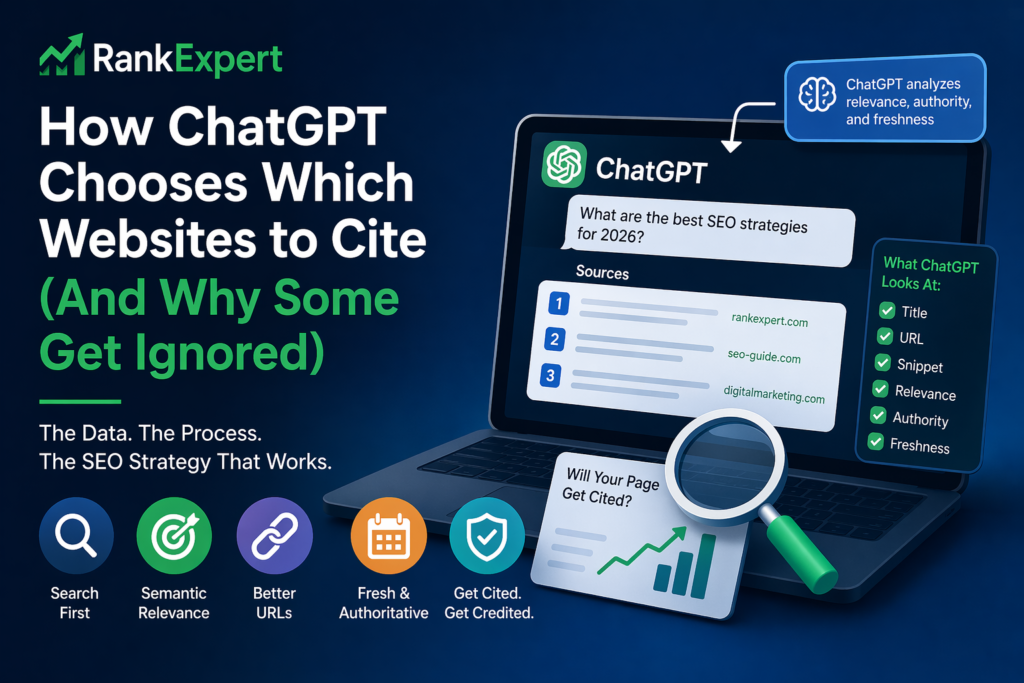
ChatGPT responses often include small blue citation links that point to external sources. These links help validate the information and improve trust. But here’s something surprising:
Even though ChatGPT retrieves dozens of web pages for a single query, it only cites about 50% of them.
So why do some pages get featured while others are ignored—even when they were retrieved?
Let’s break down how this works and what you can do to make your content more “citable” in AI-driven search.
ChatGPT Doesn’t Read Everything It Finds
When ChatGPT searches for information, it doesn’t immediately open every webpage.
Instead, it first evaluates results using:
- Page title
- URL
- Short description (snippet)
- Internal ranking signals
This means your title and URL act as a gatekeeper before your content is even read.
👉 If your metadata isn’t compelling or relevant, your page may never be opened—let alone cited.
Not All Sources Are Equal (ref_type Explained)
ChatGPT categorizes sources into different groups, such as:
- Search results
- News articles
- Reddit discussions
- YouTube videos
- Academic papers
These categories (called ref_type) have drastically different citation rates.
Key Insight:
- Search results dominate citations (~88%)
- Reddit, YouTube, and academic sources are rarely cited
👉 This means:
If your content isn’t ranking in search results, your chances of being cited drop significantly.
Why Reddit Is Used But Rarely Cited
One of the most interesting findings:
- Reddit makes up over 67% of non-cited URLs
- But it’s cited less than 2% of the time
ChatGPT uses Reddit to:
- Understand opinions
- Identify trends
- Build context
But then it prefers to cite:
👉 Trusted websites instead of community discussions
Does Metadata Like Snippets or Dates Matter?
At first glance, it looks like:
- Non-cited pages have more snippets and publication dates
- Cited pages have fewer
But this is misleading.
After deeper analysis:
- These differences come from how data is collected (especially Reddit)
- Snippets are often ignored once a page is selected for deeper reading
👉 Conclusion:
Metadata like snippets and dates are not strong ranking signals for citations.
The Real Ranking Factor: Semantic Relevance
The most important factor is semantic similarity.
ChatGPT doesn’t just match keywords—it analyzes meaning.
It compares:
- User query
- Internal “fan-out queries” (sub-questions)
- Page titles
Results show:
- Cited pages have significantly higher relevance scores
- Titles closely matching sub-questions are more likely to be selected
Fan-Out Queries: The Hidden SEO Layer
ChatGPT generates multiple sub-questions behind the scenes.
Example:
User asks: “How to build backlinks?”
ChatGPT may internally search:
- Best link building strategies
- Safe backlink methods
- SEO link building tips
👉 Your content must answer these hidden queries—not just the main keyword.
URLs Matter More Than You Think
Pages with clean, readable URLs perform better.
Example:
- ✅
/ai-search-ranking-strategies - ❌
/page?id=12345
Data shows:
- Natural language URLs have higher citation rates
Content Freshness: Important, But Not Everything
Fresh content matters—but it’s not the only factor.
Key findings:
- Average cited page is about 500 days old
- Very new pages are often ignored
- Older, established pages get cited more within the same dataset
👉 Why?
Because:
- Authority + relevance > freshness alone
When Freshness Becomes Critical (News Content)
For news-related queries:
- Relevance scores are similar across pages
- Freshness becomes the deciding factor
👉 Newer articles win when:
- Multiple pages answer the same question equally well
What This Means for SEO in 2026
To get cited by ChatGPT and other AI systems, focus on:
1. Rank in Search First
AI pulls heavily from search indexes.
2. Optimize Titles for Intent
Match real user queries and variations.
3. Target Fan-Out Queries
Answer multiple related questions in one article.
4. Use Clear URLs
Readable, keyword-rich slugs improve selection.
5. Build Authority
Older, trusted pages are preferred over brand-new ones.
6. Don’t Rely on Reddit-Style Content
AI may use it—but won’t credit it.
Final Thoughts
ChatGPT acts like a strict editor.
It:
- Filters sources aggressively
- Prioritizes semantic relevance
- Favors trusted web content
- Uses Reddit silently for context
FAQs (SEO Boost)
How does ChatGPT choose sources?
It evaluates titles, URLs, and relevance before deciding which pages to read and cite.
Why are some pages not cited?
Because they don’t match semantic intent or fail initial filtering criteria.
Does ranking in Google help with AI citations?
Yes. Most cited sources come directly from search results.
Are backlinks still important?
Yes. Authority signals still influence which pages rank—and get cited.
For More Information Visit our Homepage: