Search has always been about connecting your brand with the right audience at the right time. But that equation is changing fast. Today, you’re not just optimizing for people—you’re optimizing for artificial intelligence.
Modern tools like ChatGPT, Perplexity AI, and Google’s AI-powered search experiences don’t simply list links anymore. Instead, they analyze information, evaluate sources, and generate direct answers.
That means users often get a single response—and your brand is either included in it or completely invisible.
This shift is known as agentic search, where AI acts as the decision-maker, gathering and presenting information—and sometimes even taking actions like recommending or purchasing products.
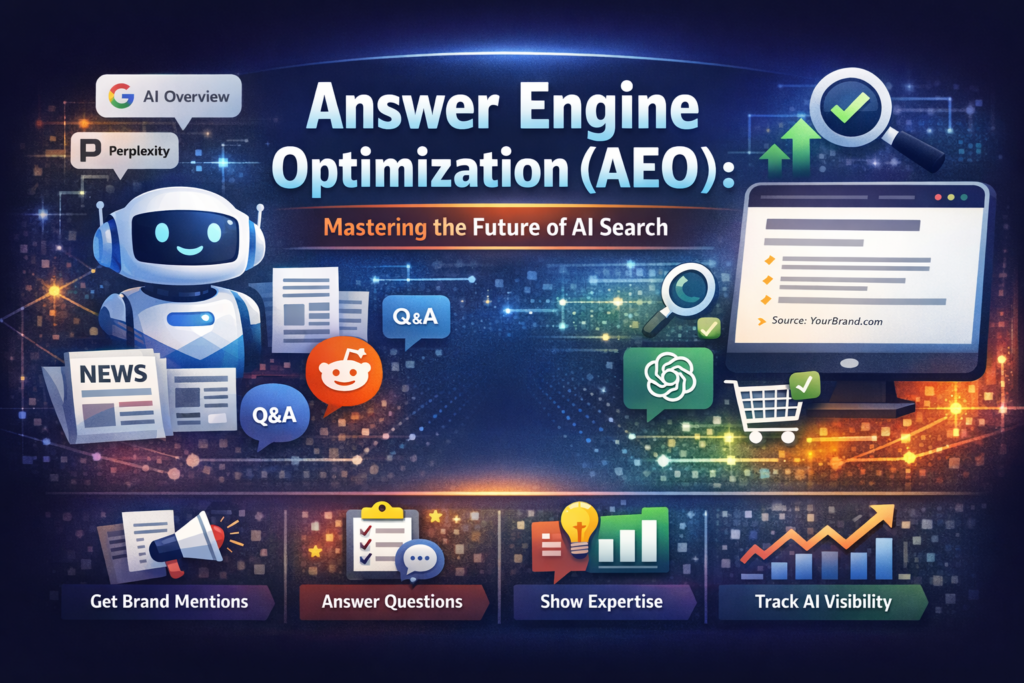
In this guide, we’ll break down Answer Engine Optimization (AEO) and show you how to make your brand visible in AI-driven conversations.
What Is Answer Engine Optimization (AEO)?
Answer Engine Optimization (AEO) is the process of optimizing your content so it appears in AI-generated responses rather than just traditional search engine rankings.
Instead of focusing only on ranking in Google’s results pages, AEO helps your brand get:
- Mentioned in AI answers
- Cited as a trusted source
- Recommended in AI-generated summaries
Ranking in traditional search does not guarantee visibility in AI tools. That’s why AEO requires additional strategies beyond classic SEO.
AEO vs SEO vs ASO: What’s the Difference?
While these terms are closely related, they serve different purposes:
SEO (Search Engine Optimization)
Focuses on ranking your website in search engines like Google Search using:
- Keywords
- Backlinks
- Technical optimization
AEO (Answer Engine Optimization)
Focuses on getting your content:
- Featured in AI-generated answers
- Cited as a reliable source
- Used in summaries
ASO (Agentic Search Optimization)
A broader concept that includes:
- AEO strategies
- Optimizing for AI decisions and actions (e.g., recommendations, purchases)
Why AEO Is More Important Than Ever
AI-powered search is rapidly changing how users find and trust information. Here’s why AEO matters:
1. AI Is Reducing Website Clicks
AI tools often provide complete answers without requiring users to visit websites. This means less traditional traffic but more importance on being included in answers.
2. Trust Is Shifting to AI
Users are starting to trust AI-generated summaries instead of browsing multiple websites.
3. AI Traffic Converts Better
Studies show that visitors coming from AI tools tend to have higher intent, leading to better conversion rates.
4. Foundation for Future AI Decisions
If your brand isn’t included in AI answers, it won’t be considered when AI tools:
- Recommend products
- Compare solutions
- Make decisions for users
How to Optimize for Answer Engines (AEO Strategies)
To succeed in AEO, you need to understand how AI systems find, interpret, and select content.
1. Build Strong Brand Mentions
AI systems rely heavily on trusted sources. Your brand needs to appear across the web in credible places.
Focus on getting mentioned in:
- News websites
- Industry blogs
- Forums like Reddit
- Educational and government sites
Consistency is key—your brand information should be accurate and uniform everywhere.
2. Answer Questions Clearly
AI tools prioritize content that directly answers user queries.
To optimize:
- Use question-based headings (H2/H3)
- Provide a clear answer immediately
- Expand with examples, data, and insights
Structure your content using:
- Bullet points
- Numbered steps
- Tables
This makes it easier for AI to extract your information.
3. Create High-Quality, Expert Content
AI systems favor content that demonstrates expertise and real-world experience.
To stand out:
- Share original insights or case studies
- Include real data and statistics
- Cite authoritative sources
- Add expert author bios
Content that reflects experience, expertise, authority, and trust (E-E-A-T) performs better in AI-generated results.
4. Keep Content Fresh and Updated
Recency plays a major role in AI visibility.
Improve your chances by:
- Updating content regularly
- Adding “last updated” dates
- Refreshing statistics and examples
- Using structured data (like publish/update dates)
Fresh content is far more likely to be cited by AI tools.
How to Measure AEO Success
Tracking AEO performance is different from traditional SEO metrics.
1. Monitor AI Mentions
Search your target queries on platforms like:
- ChatGPT
- Perplexity AI
Check if your brand appears in responses.
2. Track Brand Searches
When users see your brand in AI answers, they often search for it later.
Use tools like:
- Google Search Console
Track:
- Branded search queries
- Search impressions
- Visibility trends
3. Analyze Share of Voice
Measure how often your brand appears compared to competitors across AI platforms.
This helps you understand:
- Where you’re winning
- Where you need improvement
Real-World Example of AEO in Action
Brands that publish unique, data-driven content often get cited by AI tools.
For example, platforms like Semrush regularly appear in AI-generated answers because they:
- Publish original research
- Earn backlinks and mentions
- Stay consistently updated
This kind of content builds authority and increases AI visibility over time.
Start Optimizing for AEO Today
You don’t need to rebuild your entire SEO strategy—just adapt it.
Start with one page and:
- Add a clear answer at the top
- Optimize for question-based queries
- Use structured formatting
- Track AI visibility—not just clicks
Final Thoughts
Search is no longer just about rankings—it’s about being part of the answer.
As AI continues to reshape how users discover information, Answer Engine Optimization (AEO) will become a critical part of every digital marketing strategy.
Brands that adapt early will dominate not just search engines—but the AI systems that are replacing them.
For More Information Visit our Homepage;