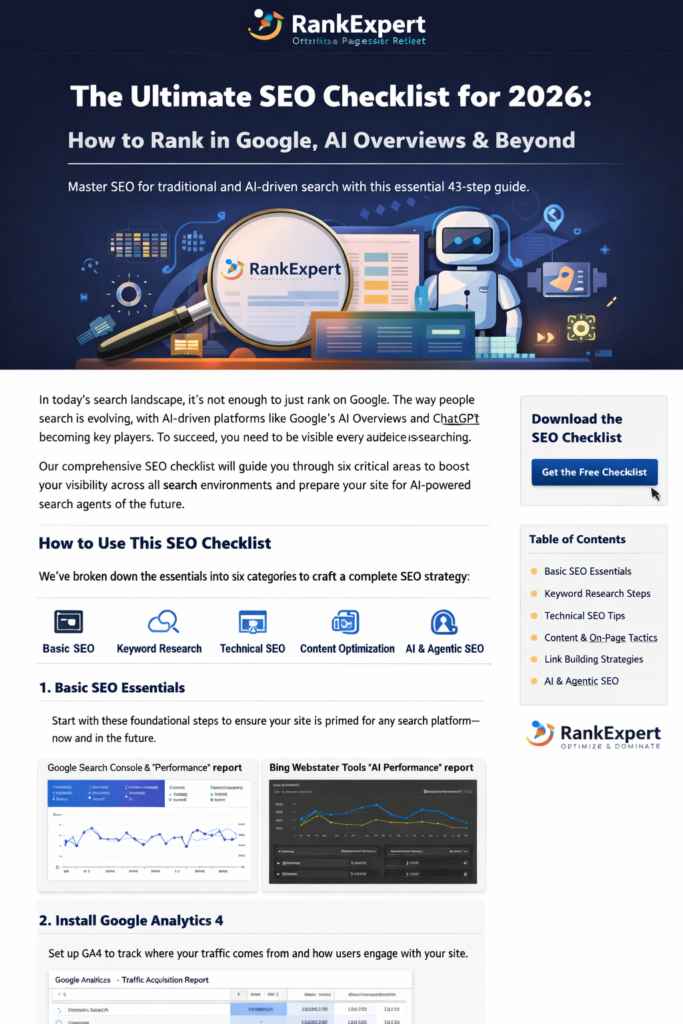
SEO in 2026 isn’t limited to ranking on search engines like Google. Today, visibility also depends on how well your content appears in AI-powered platforms such as Google’s AI Overviews, ChatGPT, and other intelligent assistants.
This complete SEO checklist is designed to help you stay visible across traditional search engines and AI-driven discovery systems. By following these steps, you’ll not only improve rankings but also prepare your website for the future of agent-based search and AI automation.
How to Use This SEO Checklist
To make implementation easier, we’ve divided the checklist into six core areas:
- Basic SEO setup
- Keyword research
- Technical SEO
- Content & on-page SEO
- Link building & off-page SEO
- AI & agentic search optimization
If you’re short on time, prioritize the sections that align with your current goals. Otherwise, work through all six for a complete SEO strategy.
1. Basic SEO Checklist (Build Your Foundation)
These steps ensure your website is ready to be discovered and indexed.
Set Up Search Console & Webmaster Tools
Use Google Search Console and Bing Webmaster Tools to:
- Track performance
- Submit sitemaps
- Detect indexing issues
Bing now includes AI performance insights, showing how your site appears in AI-generated answers.
Install Google Analytics (GA4)
Track:
- Traffic sources
- User behavior
- Engagement metrics
In 2026, traffic alone isn’t enough—focus on user actions and conversions, especially since AI often answers queries without clicks.
Use an SEO Plugin
If you’re on WordPress, plugins like:
- Yoast SEO
- Rank Math
help automate:
- Sitemap generation
- Meta tag optimization
- Schema markup
Create and Submit XML Sitemap
A sitemap helps search engines understand your site structure.
Submit it to both Google and Bing for faster indexing.
Optimize Robots.txt
Your robots.txt file controls crawler access.
Avoid blocking important pages—especially if you want visibility in AI-generated answers.
Check for Manual Penalties
Regularly review Google Search Console for:
- Spam issues
- Unnatural links
- Hidden content
Avoid black-hat tactics—even if they seem to work temporarily.
Ensure Your Site Is Indexable
If your pages aren’t indexed, they won’t appear in:
- Google search
- AI-generated answers
Run audits to confirm proper crawlability.
2. Keyword Research Checklist
Keyword research now includes both search queries and AI prompts.
Analyze Competitor Keywords
Identify keywords your competitors rank for and find:
- Missing opportunities
- Weak rankings
Find Core Topics
Use keyword tools to discover:
- High-volume terms
- Question-based queries
- Buyer intent keywords
Research AI Prompts
Understand how users interact with AI tools by:
- Studying real questions
- Analyzing forums like Reddit
- Reviewing AI-generated responses
Create a Keyword Map
Group keywords by:
- Topic
- Intent
Each group should correspond to a single page.
Analyze Search Intent
Study top-ranking pages to understand:
- Content type (guide, product, comparison)
- Depth of information
- User intent
Find Related Questions
Use:
- “People Also Ask”
- Forums and communities
Add these questions to your content as headings or FAQs.
3. Technical SEO Checklist
Technical SEO ensures your website is fast, accessible, and crawlable.
Use HTTPS
Secure websites rank better and build trust.
Fix Duplicate Site Versions
Ensure all versions (HTTP, HTTPS, www, non-www) redirect to one main domain.
Resolve Crawl Errors
Fix:
- Broken pages
- Incorrect canonical tags
Improve Site Speed
Focus on Core Web Vitals:
- LCP (loading speed)
- INP (interaction speed)
- CLS (visual stability)
Faster sites improve both rankings and AI readability.
Fix Broken Links
Update or remove:
- Internal broken links
- External dead links
Ensure Mobile-Friendliness
Google uses mobile-first indexing, so your site must work perfectly on mobile devices.
Optimize URL Structure
Good URLs are:
- Short
- Clear
- Keyword-rich
Example:
✅ /seo-checklist-2026/
❌ /page?id=123
Add Structured Data
Schema markup helps search engines and AI understand your content better.
Improve Site Architecture
Keep important pages within 3 clicks from homepage.
Fix Redirect Issues
Avoid:
- Redirect chains
- Loops
- Incorrect 302 redirects
4. Content & On-Page SEO Checklist
Content is still king—but now it must also be AI-friendly.
Optimize Title Tags
Avoid:
- Duplicate titles
- Missing tags
- Overly long titles
Write Better Meta Descriptions
Make them:
- Unique
- Engaging
- Relevant
Use a Single H1 Tag
Each page should have one clear main heading.
Improve CTR with Optimization
Update pages with:
- Low clicks but high impressions
- Better headings and content structure
Audit Existing Content
Identify:
- Underperforming pages
- Outdated information
Update them regularly.
Add Alt Text to Images
Helps with:
- Accessibility
- Image SEO
- AI understanding
Strengthen Internal Linking
Link related pages to improve:
- Navigation
- Authority distribution
Fix Keyword Cannibalization
Ensure multiple pages aren’t competing for the same keyword.
Fix Orphan Pages
Every page should have at least one internal link.
Keep Content Updated
Refresh:
- Stats
- Examples
- Trends
AI tools prefer fresh and accurate content.
5. Link Building & Off-Page SEO Checklist
Backlinks remain a key ranking factor—even in AI search.
Analyze Competitor Backlinks
Find where competitors get links from.
Run a Backlink Gap Analysis
Identify sites linking to competitors but not you.
Turn Mentions into Links
Reach out to websites that mention your brand without linking.
Build High-Quality Links
Focus on:
- Authority
- Relevance
- Natural placement
Optimize Google Business Profile
For local SEO:
- Keep information updated
- Add images and reviews
AI tools often pull local data from these listings.
6. AI & Agentic Search Optimization Checklist
This is what separates modern SEO from outdated strategies.
Track AI Visibility
Monitor:
- Mentions
- Citations
- Competitor presence in AI results
Structure Content for AI
Make content:
- Clear and direct
- Well-organized
- Easy to extract
Tips:
- Use short paragraphs
- Answer questions directly
- Avoid vague language
Use LLMs.txt (Emerging Trend)
This file may guide AI systems to your most important pages.
While still evolving, it’s worth watching.
Final Thoughts: Execute Your SEO Strategy for 2026
SEO is no longer just about ranking—it’s about visibility everywhere your audience searches, including AI platforms.
To succeed:
- Build a strong technical foundation
- Create helpful, structured content
- Optimize for both humans and AI systems
The earlier you adapt, the better positioned your website will be as search continues to evolve.
For More Information visit Our Homepage: